
Picture two restaurants using the exact same recipe. One consistently delivers a great meal, on time, every visit. The other is hit-or-miss — sometimes great, sometimes slow, sometimes just off. Same recipe, same ingredients, very different results.
That difference isn’t about the recipe. It’s about Operational Excellence.
What Is Operational Excellence?
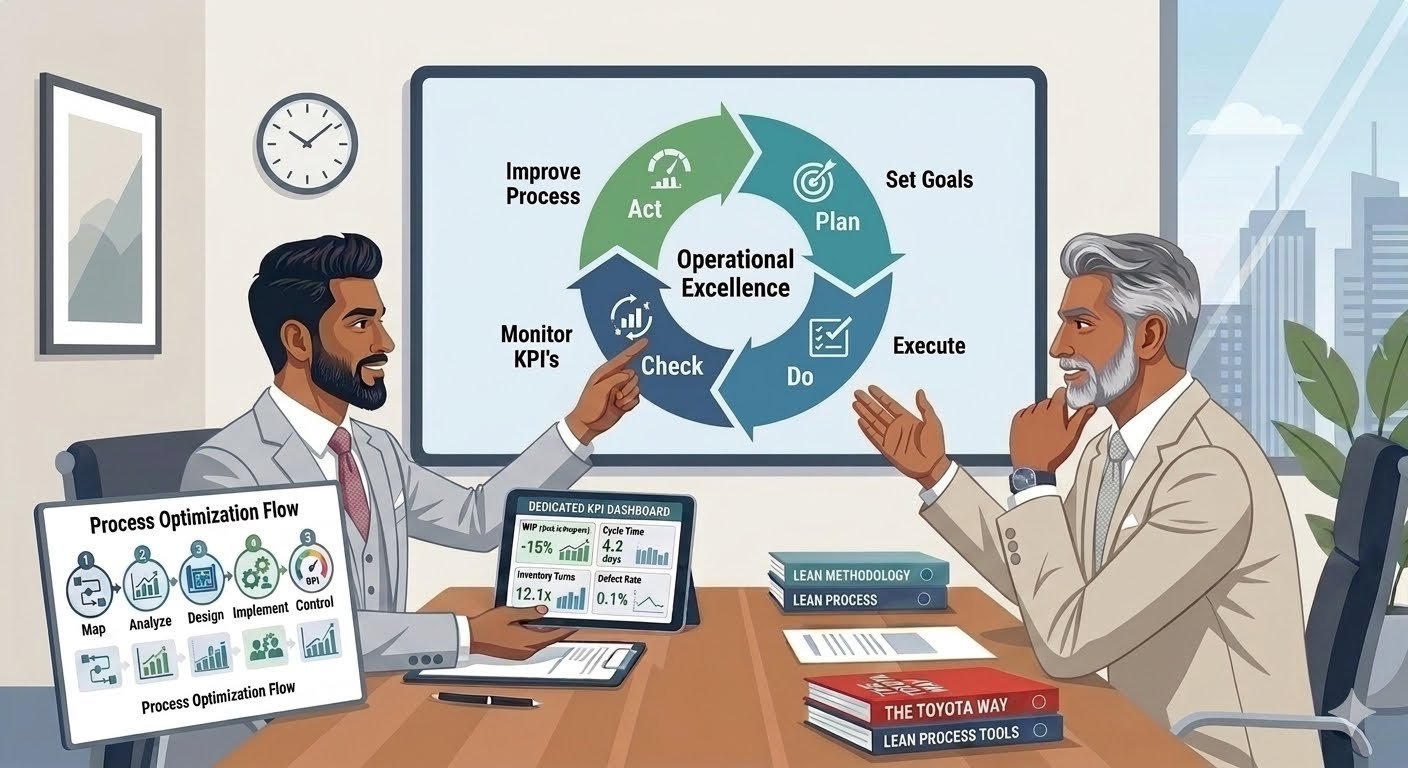
Operational Excellence is the ongoing practice of running a business’s processes so well that quality, efficiency, and customer experience stay consistently high — not as a one-time fix, but as a continuous discipline.
It’s often confused with just “being efficient,” but it’s really about balance: delivering the right quality, at the right speed, at a sustainable cost — every single time, not just on a good day.
Reactive vs. Proactive approach
Most businesses without a formal approach operate in “firefighting mode” — problems get fixed only after they cause visible damage: a customer complaint, a compliance flag, a missed deadline.
Operational Excellence flips that. Instead of waiting for problems to surface, it builds systems that catch and prevent them — so the business spends less time firefighting and more time improving.
How Businesses Actually Get There
- Process mapping: clearly documenting how work actually flows, step by step — often revealing gaps nobody knew existed.
- Eliminating waste: cutting out steps, delays, or rework that add cost but no value for the customer.
- Root cause analysis: fixing the actual source of a recurring problem, not just the symptom.
- Ongoing measurement: tracking performance with real data, so improvement is provable, not just assumed.
Why It Matters
Operational Excellence is what separates businesses that scale smoothly from those that grow into chaos. It’s the difference between a company that gets stronger under pressure, and one that starts cracking the moment demand increases.