
Ever notice how a burger from your favourite fast-food chain tastes exactly the same whether you’re in Mumbai or Manchester — but two branches of the same bank can give you completely different experiences for the same loan application?
That gap is exactly what Service Industrialization tries to close.
What Is Service Industrialization?
Manufacturing solved this problem decades ago. A factory doesn’t rely on one skilled worker’s memory to build a product correctly — it uses standardized steps, checklists, and quality checks so that output stays consistent no matter who’s on the line, or which shift is running.
Services — banking, healthcare, telecom, hospitality — have historically worked the opposite way. Quality often depends on which employee you get, how experienced they are, or even what kind of day they’re having.
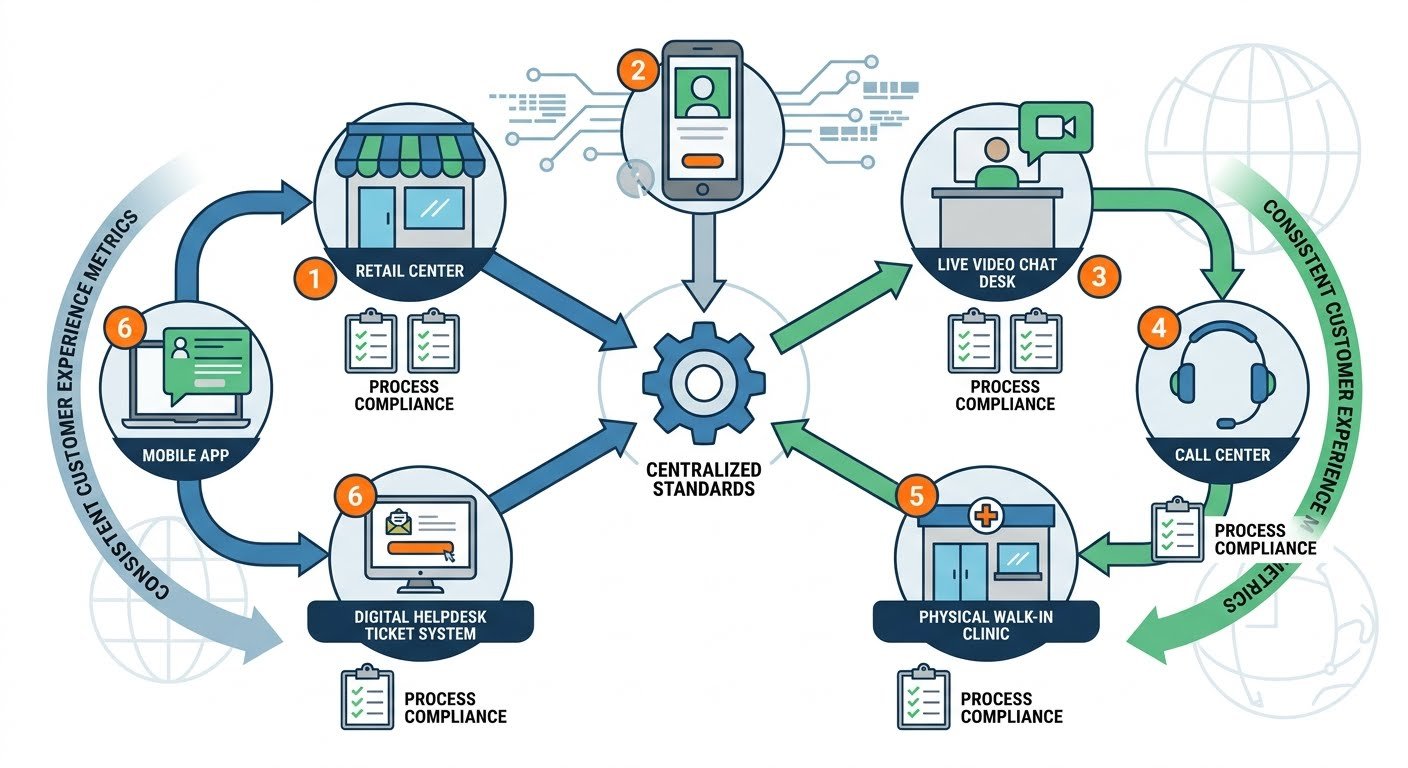
Service Industrialization means applying the same discipline factories use — standardized processes, clear steps, defined quality checkpoints — to services. The goal is simple: make the customer experience reliably good, every time, regardless of who delivers it.
Why This Matters More Than Ever
As service businesses scale, inconsistency becomes expensive. A bank with 200 branches can’t rely on each branch manager’s personal judgment to process loans correctly — it needs the same documentation, the same checks, and the same turnaround time everywhere.
Inconsistency isn’t just an efficiency problem. In regulated industries like BFSI, it’s also a compliance risk and a trust risk. Customers don’t just want a good outcome — they want a predictable one.
What It Looks Like in Practice
- Standardized checklists: Every employee follows the same steps for tasks like loan documentation or customer onboarding, regardless of branch or shift.
- Defined resolution paths: Complaint is handled the same way whether it comes in through a call center, email, or in person.
- Built-in quality checkpoints: Errors are caught before they reach the customer, not after.
- Measurable service standards: “fast” or “accurate” isn’t a feeling — it’s a number everyone is accountable to.
The Bigger Picture
Service Industrialization isn’t about turning people into robots — it’s about giving them a standardized system to work within, so good service doesn’t depend on luck, memory, or individual heroics. When that system is in place, businesses can scale without quality falling apart, and customers get an experience they can actually count on.