
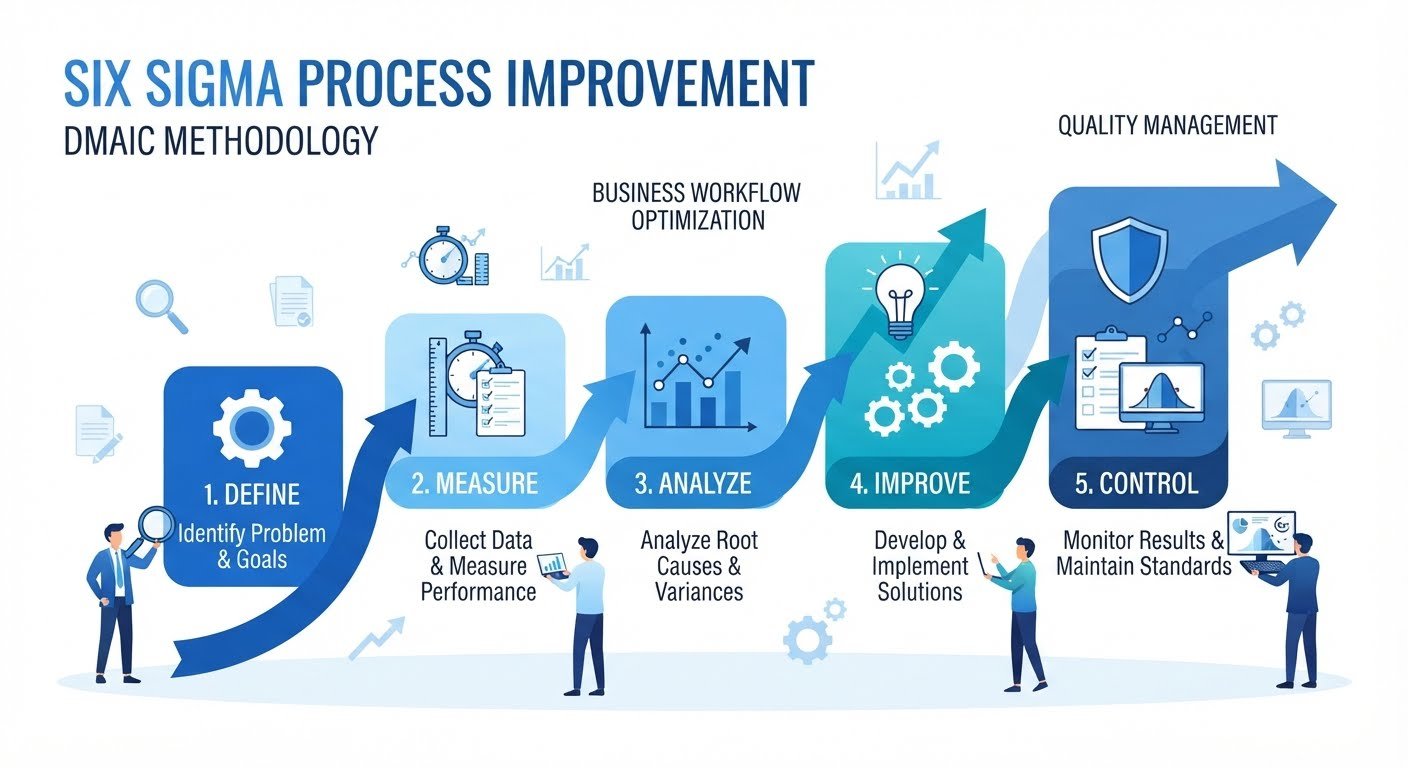
Have you ever ordered your favourite coffee, and it tasted completely different than it did yesterday? Or bought a product that broke the very first time you used it?
In business, these annoying inconsistencies are called defects and variations. They cost companies billions of dollars and ruin customer trust.
To fix this, the world’s biggest companies use a system called Six Sigma.
While it sounds like a complicated math formula, the core idea is actually incredibly simple. Here is a layman’s guide to what Six Sigma is and why it matters.
What is Six Sigma?
Think of Six Sigma as a disciplined approach to helping organizations deliver products and services consistently by reducing errors and improving the way work is performed.
It is a business method that uses data and facts to make processes—like manufacturing a phone, shipping a package, or handling a customer service call—as close to perfect as humanly possible.
Instead of managers guessing how to fix a problem, Six Sigma forces a company to look at hard numbers to find exactly where mistakes are happening and stop them permanently.
What Does the Name Actually Mean?
The term ‘Six Sigma’ often creates the impression that it is a mathematical concept. While the methodology does use statistics, the name simply represents a very high level of process performance.
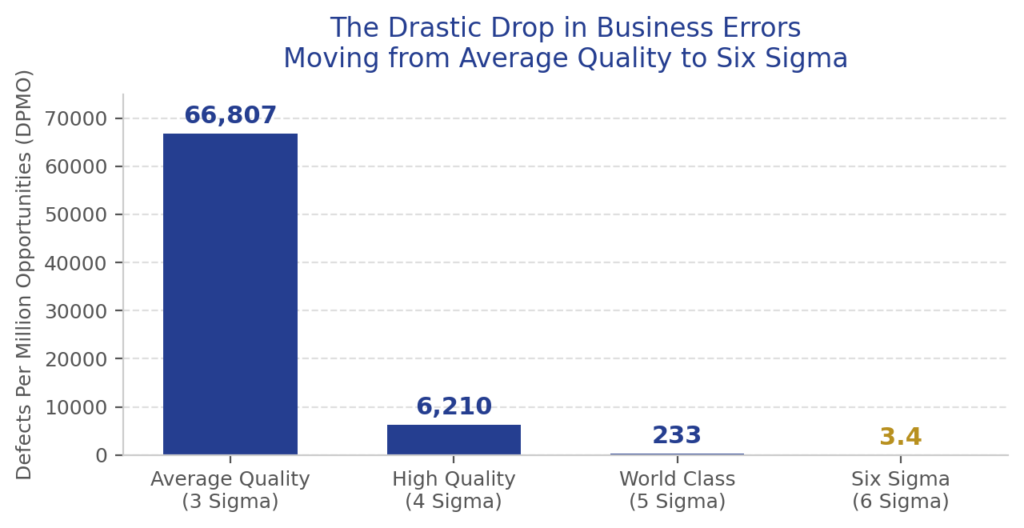
While a regular business usually operates at a 3 or 4 Sigma level, a Six Sigma business virtually never makes a mistake. It is the gold standard for quality. When a company says they have reached a Six Sigma level, it means their process is 99.99966% accurate. To put that in plain English, out of one million things they do, they make only 3.4 mistakes.
The whole concept is explained with the help of below chart:
The Story Behind It
- Born at Motorola (1986): An engineer named Bill Smith created it because Motorola needed a way to build electronic parts without constant defects.
- Made Famous by General Electric (1990s): GE’s famous CEO, Jack Welch, made Six Sigma mandatory for his entire company. It saved GE billions of dollars, and soon, every major company in the world wanted in.
How People Get Trained in Six Sigma
To build this reliability, employees undergo structured training and receive “belts” based on their expertise:
- White Belt: Understands the basics & supports local problem-solving.
- Yellow Belt: Applies basic tools & helps collect data for larger projects.
- Green Belt: Leads departmental improvement projects with their day-to-day role.
- Black Belt: Drives complex, cross-functional projects using advanced tools.
- Master Black Belt: Sets enterprise-wide strategy and trains other belts.
Each certification level builds practical problem-solving skills that professionals can apply immediately within their own workplace.
Six Sigma in Everyday Life
Remember the coffee that tasted different, or the product that broke on day one, from the start of this post? Chances are, somewhere on the other end of a smooth experience, a Six Sigma-style process is quietly at work. You rarely notice it directly — you just notice the consistency it creates.
- Airlines: Reducing mishandled baggage and flight delays.
- Fast-food chains: Ensuring your order tastes the same at every outlet, every time.
- Banks: Streamlining loan processes to avoid rework and delays.
- Online retailers: Making sure the package that arrives matches what you ordered.
You don’t see Six Sigma itself — you just experience the reliability it leaves behind. That invisible consistency is the entire point of the methodology.
Conclusion: Driving Toward Perfection
At the end of the day, Six Sigma is about consistency. It proves that with the right data and a commitment to quality, any business can eliminate chaos and deliver a flawless product/experience to its customers. Whether you are running a local bakery or a global tech giant, aiming for your own “Six Sigma” standard is the ultimate way to build a brand that people trust.